How Often Should You Wash a Car? A Condition-Based Plan
Use exposure, visible soil and model-specific guidance to decide when a wash is useful instead of following a rigid calendar.
There is no single safe interval for every vehicle. A useful car wash schedule starts with what is on the finish, where the car is stored, recent weather, and the instructions for that specific vehicle. Calendar reminders can prompt an inspection, but they should not replace one.
Review boundary: This article provides a conservative decision framework, not a promise of paint safety or a model-specific service interval. The vehicle, surface, product, and equipment manufacturer instructions control whenever they are more specific.
Why a fixed car wash schedule can mislead
Two vehicles driven for the same amount of time can accumulate very different contamination. One may stay in a garage and travel on dry paved roads. Another may sit under trees, encounter construction dust, or travel on roads treated during winter weather. A rule based only on elapsed time ignores those differences.
Technique also changes the decision. Washing is a contact process unless a manufacturer-approved touchless method is used. Poorly maintained tools, a dry panel, or aggressive pressure may create avoidable risk. On the other hand, leaving an unfamiliar residue in place without checking the manual is not automatically the cautious choice. The practical goal is not to wash as often as possible or as rarely as possible. It is to respond to actual conditions with the least aggressive suitable method.
The Toyota Tacoma manual linked in the references includes model-specific exterior-cleaning cautions and directions. It is an example of why the owner’s manual should come before a generic timetable. It does not establish one schedule for all Toyotas or other vehicles.
Start with an exposure check
Inspect the vehicle in useful light when the surface is cool enough to assess safely. Look across horizontal panels, lower doors, wheel-adjacent areas, glass, trim, and seams. Do not rub a dry fingertip across dust to decide whether it is present.
Conditions that may justify earlier attention
- Bird residue, insect remains, sap-like material, or other localized deposits
- Road film, winter road contamination, mud, or splash from standing water
- Pollen, leaves, seed pods, or material from parking beneath vegetation
- Dust from construction, unpaved roads, or wind events
- A spill or overspray of unknown origin
- Reduced visibility through exterior glass or contamination around lamps and cameras
These observations are triggers to consult appropriate instructions and choose a response. They are not proof that scrubbing, a particular chemical, or an automatic wash is suitable.
Conditions that may support waiting
A vehicle may not need a complete wash merely because a reminder appeared. If inspection finds no meaningful buildup, visibility surfaces are clear, and the owner’s manual does not call for action after a recent exposure, another inspection later may be reasonable. A clean-looking vehicle can still have localized material, so check rather than assume.
Give priority to time-sensitive contamination
Not all soil should be treated as routine dust. If a deposit appears likely to react with or adhere to a surface, review the manual promptly. Identify the material when possible without handling it. Use the gentlest compatible removal procedure specified by the vehicle or relevant surface-care product maker.
Do not improvise with household solvents, abrasive pads, or mixed cleaners. If the substance is unknown, hazardous, widespread, or located near damaged paint, seek qualified guidance. A quick response is useful only when the response itself is appropriate.
Winter exposure deserves the same condition-based reasoning. Road-treatment practices vary by location, and a generic article cannot identify what is on a particular road. Inspect the body, wheel areas, and accessible lower surfaces after relevant travel. Follow the vehicle maker’s directions for washing and any underbody considerations. Do not place yourself beneath an unsupported vehicle or direct equipment into components contrary to the manual.
Build a practical inspection rhythm
A calendar can still be helpful when it serves as a reminder to look. Choose inspection prompts that fit how the vehicle is used: after a long trip, after severe weather, after parking under trees, or when seasonal road treatment begins. The prompt should ask “What changed?” rather than command “Wash now.”
Keep a brief maintenance note with:
- The inspection or wash date
- Recent weather and driving conditions
- The contamination observed
- The method and products used
- Any area intentionally left untreated
- Any change in gloss, texture, trim appearance, or water behavior that needs review
This record can reveal patterns without turning them into universal rules. It can also prevent repeated treatment of a mark that may actually be a defect requiring evaluation.
Choose the least aggressive adequate response
Localized response
A small, identified deposit may call for a manufacturer-approved spot procedure rather than a full wash. Protect surrounding surfaces, prevent the product from drying when its instructions say not to, and stop if appearance changes. “Spot cleaning” does not mean working on a dry, gritty surface.
Rinse or low-contact response
Loose material may sometimes be reduced with an appropriate rinse, subject to the vehicle instructions, water restrictions, site drainage, and equipment directions. A rinse does not necessarily remove bonded road film. Do not increase pressure simply because residue remains.
Complete wash
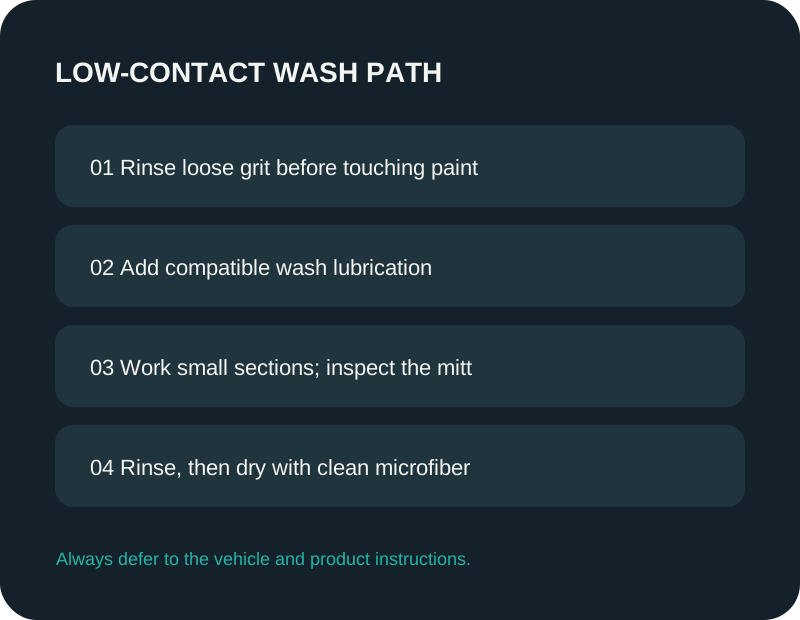
A complete wash may be appropriate when contamination is widespread or a partial response would leave uneven residue. Prepare clean tools, compatible wash solution, suitable shade or temperature conditions, and a drying plan before beginning. Work in a sequence that limits recontamination, and keep wheel-contact tools separate from bodywork tools.
Environmental and site decisions matter
The EPA source linked below explains that runoff from developed areas can carry pollutants to waterways and identifies vehicle-care activity as a potential contributor. That supports managing wash water responsibly; it does not prescribe one legal method for every address.
Before washing, check local water restrictions, stormwater rules, property policies, and any requirements for commercial facilities. Avoid allowing wash water or chemicals to enter a storm drain when local guidance prohibits it. A permitted commercial wash may be a practical alternative where home washing is restricted or drainage cannot be managed appropriately.
A pre-wash checklist
Before deciding to wash, confirm:
- The vehicle manual has been checked for relevant exterior guidance.
- The surface is not unusually hot and weather will not force products to dry prematurely.
- The contamination is understood well enough to choose a method.
- Products explicitly allow use on the identified finish or material.
- Wash media and drying materials are clean and suitable for their assigned tasks.
- Wheel and lower-body tools will not be reused on more delicate areas.
- Water, runoff, and workspace practices comply with local requirements.
- There is enough time to complete rinsing and drying as directed.
If an item cannot be confirmed, delay the wash or narrow the task until it can.
When to stop or ask for help
Stop before or during washing if paint is peeling, recently repaired, unusually soft, or otherwise outside known instructions. Also pause for unknown overspray, suspected chemical fallout, mold-like growth, petroleum residue, electrical damage, or contamination associated with a collision or flood.
Do not continue when a cleaner changes color, gloss, or texture; when a mitt or towel is dropped; when wind is depositing grit; or when solution is drying faster than it can be managed. Replace contaminated materials and reassess. Persistent marks may be below-surface defects rather than dirt. Repeated rubbing is not a diagnosis.
Frequently asked questions
How often should you wash your car if it is garaged?
Garage storage may reduce some outdoor exposure, but driving conditions and localized deposits still matter. Inspect the vehicle and follow its manual rather than assigning a longer interval automatically.
Should a car be washed after rain?
Rain alone does not determine the answer. Inspect for road film, splash, deposits, and visibility concerns after the event. Use those findings and manufacturer guidance to decide.
Can washing too often damage paint?
Any contact process can create risk when tools, products, or technique are unsuitable. Frequency by itself does not describe that risk. Appropriate materials, clean media, controlled contact, and model-specific directions remain important at every wash.
Is an automatic wash always safer than washing at home?
No universal comparison is supportable. Equipment, maintenance, chemistry, vehicle features, local rules, and operator technique vary. Check the vehicle manual for restrictions and ask the facility about its process if compatibility is uncertain.
Does a coating eliminate the need to wash?
Do not assume it does. Follow the coating installer or manufacturer’s maintenance instructions together with the vehicle manual. A coating claim should not be extended beyond its written terms.
What if I do not know what is on the paint?
Avoid aggressive wiping or improvised chemistry. Document the location and appearance, consult vehicle and product guidance, and obtain qualified help if identification or safe handling remains uncertain.
Sources and decision limit
The source links in the sources section were inspected during drafting. They support the general emphasis on model-specific exterior guidance and responsible runoff management; they do not prove compatibility for every product, finish, machine, location, or situation. The final wash decision belongs to the applicable manuals, labels, local requirements, and observed condition of the vehicle.