The Two-Bucket Car Wash Method, Explained Without Guarantees
Understand what the rinse bucket is intended to do, where the method can fail and how to reduce avoidable paint contact.
The two-bucket car wash method separates fresh wash solution from a container used to rinse wash media. Its intended role is contamination control: soil removed from the vehicle has a place to be released before the mitt or pad returns to the wash solution. It does not make contact risk-free, correct incompatible chemistry, or guarantee that paint will remain unmarked.
Review boundary: This is a conservative process framework. Vehicle, surface, wash-product, and equipment instructions take priority whenever they are more specific.
What the second bucket can and cannot do
In a conventional setup, one bucket contains the wash solution prepared according to its label. The other contains rinse water. After cleaning a limited area, the user rinses the media, inspects it, and then reloads it with wash solution. This separation may help keep obvious contamination out of the solution bucket.
The bucket count is not a quality guarantee. A grit-filled mitt, unsuitable brush, dirty towel, dried-on solution, or excessive pressure can defeat the process. Soil may remain suspended in rinse water, become trapped in fibers, or transfer from a hand or bucket rim. A dropped mitt does not become suitable merely because it was dipped in rinse water.
Treat the method as one control in a larger system: inspection, pre-rinsing, clean tools, compatible chemistry, limited contact, and prompt drying all matter.
Check the vehicle and work area first
Read the exterior-care section of the model-specific manual before choosing a wash process. The Toyota Tacoma source linked below provides an example of manufacturer cleaning directions and cautions; it does not establish universal compatibility for other vehicles, model years, finishes, decals, wraps, accessories, or repairs.
Inspect the vehicle for peeling clear coat, loose trim, damaged seals, cracked lamps, aftermarket graphics, fresh repairs, or unusual deposits. Ask the repairer or material maker for care instructions when the original manual no longer describes the surface.
Choose a location where products can be managed before they dry. Check local water-use, property, and stormwater rules. The EPA reference explains that runoff can carry pollutants from developed areas and identifies vehicle-care runoff as a concern. Local authorities determine what is permitted at a particular site.
Gather and separate the tools
A practical setup may include:
- Two clean, identifiable buckets reserved for vehicle care
- Compatible wash solution measured according to its label
- Clean wash media approved for the intended surface
- A hose or other rinse equipment used within its instructions
- Separate tools for wheels, tires, lower panels, and bodywork
- Clean drying materials and a protected place to set them
- Appropriate personal protective equipment when a product label requires it
Bucket inserts or screens are optional equipment, not proof that particles are permanently isolated. Follow their makers’ directions and inspect them for trapped sharp debris. Do not use food containers or vessels that may be confused with drinking water.
Prepare before paint contact
Inspect and cool the surface
Work only under conditions permitted by the vehicle and product instructions. If the surface is hot, wind is carrying grit, or direct sun will dry solution too quickly, change the conditions or postpone the task. Remove jewelry or other items that could contact the bodywork.
Address wheels as a separate system
Wheel finishes, brake components, tires, and body paint may have different care requirements. Use tools assigned to those areas and do not return them to the paint buckets. Follow wheel and vehicle-maker guidance; do not assume a body shampoo or wheel chemical is compatible everywhere.
Pre-rinse loose material
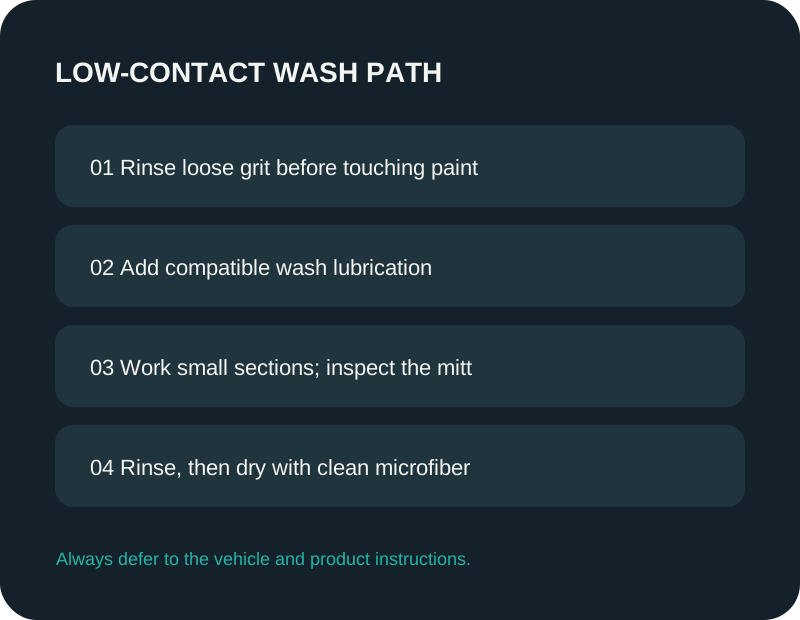
Where permitted, rinse loose soil before using wash media. Use equipment at a distance and setting allowed by its instructions, and avoid directing water where the manual warns against it. A pre-rinse can reduce the burden on contact washing, but it cannot be assumed to remove bonded contamination.
Step-by-step two-bucket workflow
Prepare the solution accurately
Clean both buckets before use. Prepare wash solution according to the product label rather than making it stronger for a dirty vehicle. Fill the rinse bucket with clean water. Keep the containers positioned so the roles remain obvious.
Load clean wash media
Start with media that has been laundered, inspected, and protected from dust. Saturate it with wash solution as directed. If it feels gritty, contains visible debris, or has an unknown residue, do not use it on a sensitive surface.
Clean a manageable section
Begin on an area that is not heavily contaminated and use light, controlled passes. Avoid repeatedly working a stubborn mark. The right section size depends on temperature, product behavior, and vehicle shape; the goal is to rinse before solution dries.
Rinse and inspect the media
Move the media to the rinse bucket. Release soil using a motion compatible with the media and insert instructions. Inspect both sides and seams. If contamination remains embedded, set that item aside. Rinse water becoming dirty is information, not proof that all soil left the fibers.
Reload, continue, and change materials
Return cleaned media to the solution bucket only after inspection. Work from less contaminated areas toward dirtier lower sections, while respecting vehicle guidance. Replace media, solution, or rinse water whenever visible soil, debris, or unknown residue makes continued use questionable.
Final rinse and dry
Rinse as the vehicle and wash-product instructions direct. Do not let residue dry. Use clean, appropriate drying material with minimal pressure, or manufacturer-approved equipment. Water retained in mirrors, handles, seams, and trim may emerge later, so inspect those areas without forcing tools into them.
Process checklist
Before starting, verify:
- The manual and product label have been reviewed.
- Weather and panel temperature permit the planned process.
- Both buckets and all media are clean.
- Paint tools are separated from wheel and lower-area tools.
- The wash solution is mixed only as directed.
- A drying plan is ready before the final rinse.
- Runoff can be handled under current local rules.
During the wash, ask:
- Is solution drying or becoming difficult to rinse?
- Has any tool touched the ground or a contaminated surface?
- Is grit visible in the media, water, or on the panel?
- Has gloss, color, or texture changed?
- Is an unknown stain resisting gentle cleaning?
A “yes” calls for a pause and reassessment, not more pressure.
Common failure points
Using one mitt for every surface can move heavy contamination from wheels or rocker areas to upper paint. Letting the mitt rest on a bucket rim can also reintroduce dirt. Overloading the solution with soap may make rinsing harder and departs from the label. Continuing after the rinse bucket becomes visibly contaminated ignores the reason for using it.
Another failure is treating friction as the answer to bonded material. Road tar-like spots, sap-like deposits, overspray, and mineral marks may require identification and a separate approved procedure. The two-bucket method is a maintenance-wash process, not a correction process.
Stop and decision limits
Stop if paint is peeling, a repaired area lacks clear care instructions, a product changes the surface, or water reaches a component contrary to the manual. Pause if weather changes, the work area becomes dusty, or you cannot prevent products from drying.
Seek qualified help for unknown chemical contamination, widespread overspray, flood or collision residue, or marks that may require abrasion or polishing. This article does not establish a polishing procedure or certify any chemical combination.
Frequently asked questions
Is the two-bucket method scratch-proof?
No. It is a contamination-control approach, not a guarantee. Surface condition, loose particles, pressure, media, chemistry, and technique all affect risk.
Do I need a bucket insert?
Follow the insert and bucket makers’ directions. An insert may help organize a process, but it does not make dirty media clean or establish compatibility with paint.
Can the rinse water be reused?
Do not reuse visibly contaminated or chemically questionable water on the vehicle. Dispose of wash water according to local requirements rather than assuming a storm drain is appropriate.
Should wheels be washed with the same buckets?
Separate wheel and body tools reduce cross-contamination. Because wheel finishes and products vary, consult their specific instructions instead of treating them as body paint.
What if the wash mitt falls on the ground?
Set it aside. Use another clean, inspected item. A quick rinse may not reveal embedded particles.
Is a foam pre-wash a substitute for two buckets?
These are different process choices. Follow the foam, equipment, and vehicle instructions; do not assume either method eliminates contact or guarantees removal.
How should I evaluate whether the method helped?
Judge the process by controllable observations rather than a promise of a flawless finish. Note whether loose soil was removed before contact, whether wash media was inspected between sections, whether dirty tools stayed away from the paint, and whether the vehicle manual’s restrictions were followed. Under suitable lighting, inspect for remaining contamination without rubbing it to “test” the surface. If a mark persists, identify it before escalating the chemistry or pressure. A single wash cannot prove that no new defect was created, and a clean-looking panel does not establish that every product was compatible. Keep a short log of the sequence and any unusual condition so the next wash can begin from evidence instead of memory.
Sources and decision limit
The references in the sources section support consulting model-specific exterior guidance and managing vehicle-care runoff responsibly. They do not prove that this method, a particular accessory, or any product is compatible with every finish or location.